
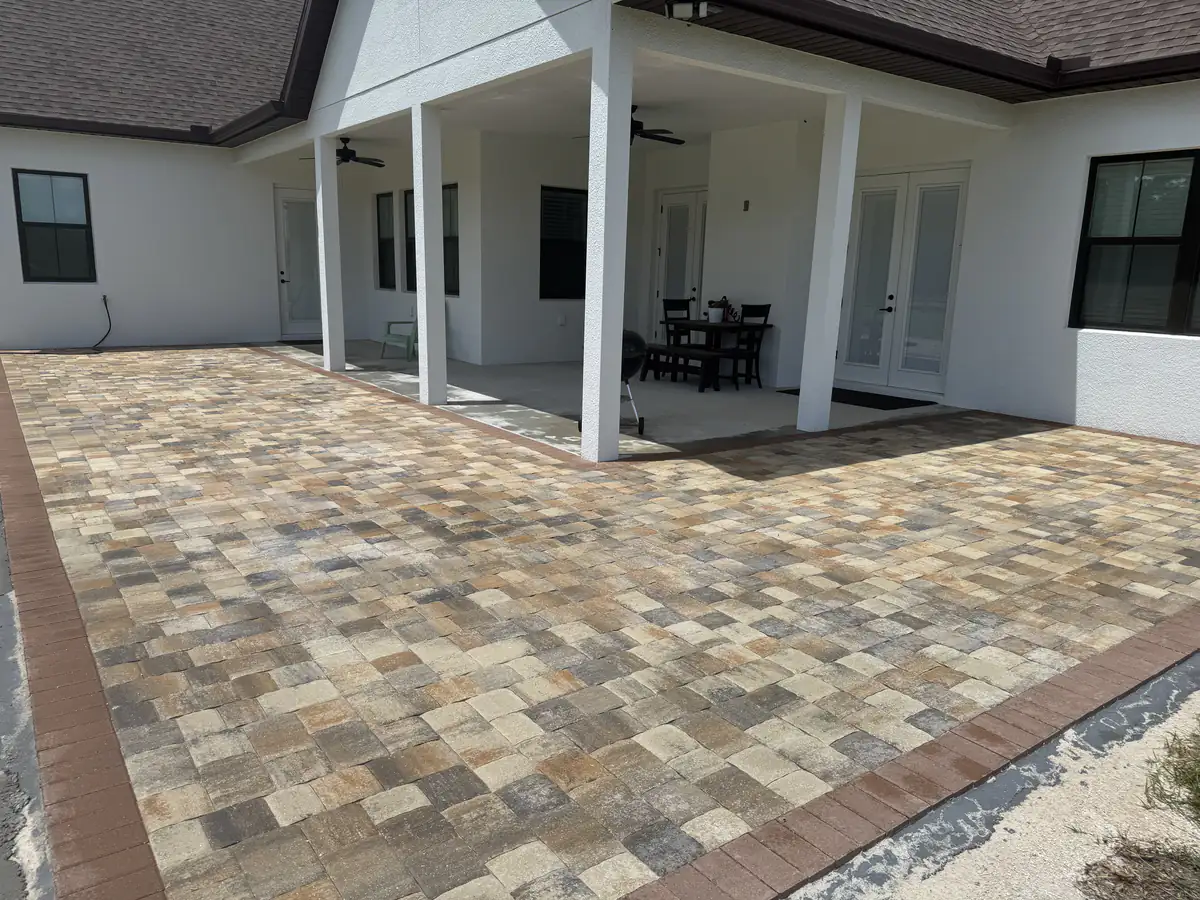
Why extend a covered lanai with a paver patio instead of more concrete?
Because concrete cracks and pavers flex. This paver patio in Ocala pushes the living space out past the covered lanai, into the sun, and it does it without adding another slab that will split the first time the ground moves.
Stamped concrete is the usual alternative people bring up. It looks good on day one. It is still a slab, though, and when it cracks the pattern breaks right across the crack, and no patch ever quite hides that. Pavers are individual units. If one gets damaged, it lifts out and a new one drops in.
Natural stone is the other option. It costs more per square foot, and matching it years later can be hard because every quarry lot looks a little different.
Most of our customers end up with pavers for exactly those reasons. The paver patios page has more on patterns and sizes if you are comparing.
Should a new patio sit on its own base next to the lanai slab?
Yes, and that is what makes this one a stand alone patio. It is built on its own compacted base out in the yard, meeting the existing lanai at the edge rather than depending on it.
The reason is sand. Ocala sits on sandy soil that does not compact naturally, so the ground outside a lanai needs real preparation before it can carry anything. For patios we typically excavate 8 to 10 inches, rebuild with layers of compacted aggregate, then lay and compact a bed of limestone screenings. Only after that do the pavers go down. It is not glamorous work. It is most of what you are paying for.
Grading matters just as much. Water coming off the lanai roof has to run away from the house, not toward it, and it cannot be allowed to pool on the new surface.
Heavy summer storms test that grading every year. Our page on pavers in Ocala goes deeper into how we handle local soil and drainage.
Which paver colors hold up on a patio in full Florida sun?
Warm, mid tone blends are a safe bet. This patio uses a tan, gold and brown mix, finished with a red brown border that picks up the darker trim on the house.
Color choice is partly about looks and partly about comfort. Lighter pavers stay cooler underfoot than dark ones in direct sun, and this patio gets plenty of it once you step out from under the lanai. A very dark charcoal would look sharp against the white stucco. It would also be hot by two in the afternoon.
Blends hide dirt, too. Pollen, a little tracked sand, a dropped leaf: they vanish into a mixed surface in a way they never would on a single flat color.
The palette keeps growing. Manufacturers release new shapes and tones every year, so we bring current samples to the consultation. You can compare Belgard pavers with Flagstone pavers right against your own wall and pick in real light.
How do you keep a sunny paver patio looking new?
Lock the joints, seal the surface, and reseal on schedule. That covers most of it.
The joints on every patio we build get Gator Maxx G2 polymeric bonding sand, the only joint sand we use. It hardens enough to hold the pavers together and give weeds nothing to root into, and it resists washout when a summer storm dumps an inch of rain in half an hour. Then we seal the surface. After that we recommend resealing every two to three years, which keeps the color from fading in the sun and makes spills easier to clean up.
Weeds and low spots are the two problems owners worry about most. Neither one is really a paver problem. When a patio fails, it almost always comes back to how the base was built.
Thinking about something similar behind your own lanai? Request a free estimate and we will come out, measure, and talk it through with you.
PROJECT GALLERY
Every Photo From This Job
YOUR PROJECT COULD BE NEXT
Is your lanai too small for the way you use your backyard?
Call (352) 651-6077 and we will measure the space and show you current paver samples on site.