
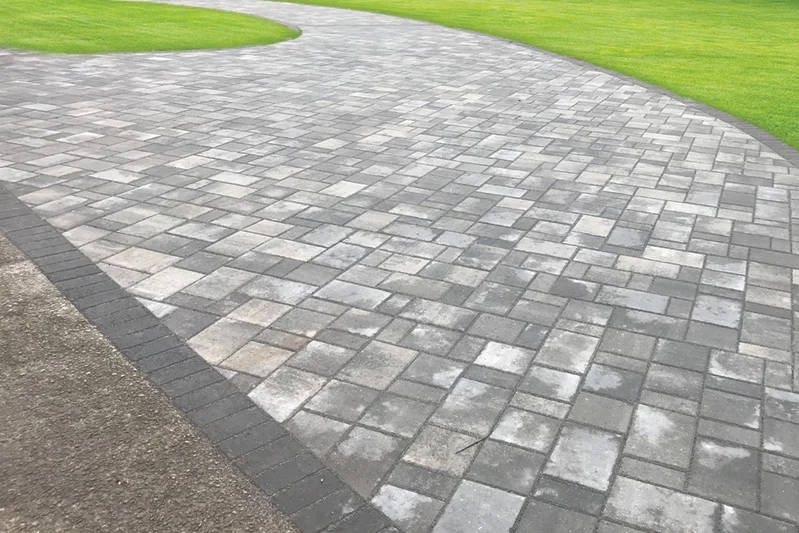
If your paver driveway is cracking and it was installed over an existing concrete slab, you are dealing with one of the most common installation mistakes in the paver industry. The good news is that the fix is more straightforward than most homeowners expect. Contact Benchmark Pavers at (352 )651-6077 if you suspect your driveway was installed this way.
What are veneer pavers, and what are they actually designed for?
Veneer pavers are thinner than standard pavers, typically 1 1/4 inches thick compared to the 2 3/8 inches required for surfaces that carry vehicle traffic. The manufacturer specification for veneer pavers is clear: they are intended for foot traffic areas only, such as patios, pool decks, and lanais. They are not rated to handle the weight and repeated load cycles of vehicles driving over them.
That specification exists because the physics of vehicle load over time will crack a 1 1/4" paver. The weight of a car, repeated daily across thousands of cycles, exceeds what that thickness can sustain. A patio sees foot traffic and occasional furniture movement. A driveway sees vehicle weight. The two applications have fundamentally different structural requirements.
Why do some contractors install veneer pavers on driveways if they are not rated for it?
The short answer is cost and ease. Installing veneer pavers over an existing concrete driveway avoids the excavation and base work required for a full installation. It is faster, requires less labor, and uses a thinner, often less expensive paver. For the contractor, it can look like a reasonable shortcut. For the homeowner, it looks fine for a year or two and then starts cracking.
This installation approach creates a situation where the homeowner paid for a driveway they believed was properly installed, watched it deteriorate within a few years, and now faces a replacement project. Benchmark Pavers regularly receives requests to fix exactly this situation. The original work looked like a paver driveway. It simply was not built like one. See what a properly installed paver driveway actually requires from the ground up.
What does fixing a veneer paver driveway actually involve?
The full fix is a complete removal and reinstallation. That means removing the veneer pavers, removing the concrete slab underneath, and starting the installation from scratch using the correct pavers rated for vehicular traffic. It is not possible to simply swap out the thin pavers for thicker ones when the slab beneath is still there, because the slab itself creates a rigid surface that prevents the drainage and slight flex a properly constructed paver base allows.
The concrete removal sounds more disruptive than it usually is in practice. For most residential driveways, breaking out and hauling off the concrete slab takes Benchmark Pavers approximately half a day. It is not the week-long demolition project homeowners often imagine. Once the concrete is out, the new installation proceeds on a properly prepared aggregate base with the correct 2 3/8" vehicular-rated pavers.
How do you know if your paver driveway was installed this way?
A few indicators suggest a veneer-over-concrete installation. Cracking pavers within the first two to five years of installation is the most visible sign, particularly cracking that appears in lines or runs across multiple pavers in the same direction. An unusually low original installation cost compared to other quotes is another signal worth investigating.
You can also check the paver thickness directly. If you can safely access an edge paver or a section where a paver has already lifted or cracked, the thickness of the paver itself is visible. A 1 1/4" measurement confirms a veneer product. If you are not sure or cannot check safely, a professional assessment will tell you what you are working with.
Is the concrete removal worth the cost, or is there a simpler fix?
There is no effective long-term fix that leaves the concrete in place. Patching individual cracked pavers addresses the symptom but not the cause. As long as vehicular load continues on a veneer surface, the cracking will continue. The concrete below does not change the structural limitation of a thin paver above it. The only path to a driveway that performs correctly for the long term is a proper installation using the right materials. Reach out to Benchmark Pavers at (352 )651-6077 for an honest assessment of what your driveway actually needs.
Get in touch with us
Don’t hesitate to get in touch with us today to schedule a consultation and learn how we can help you achieve your construction goals.