
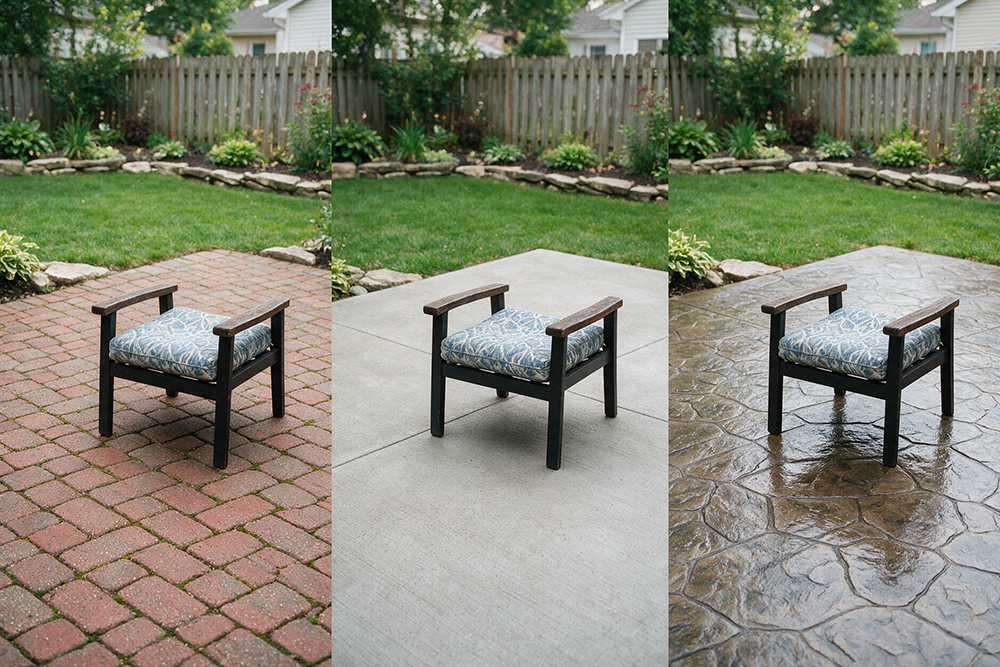
Choosing between pavers, poured concrete, and stamped concrete is one of the first decisions homeowners face when upgrading a driveway or patio, and the answer genuinely matters for how the surface performs ten years from now. Each material has real strengths and real trade-offs. Contact Benchmark Pavers at (352) 651-6077 to talk through which option fits your property and your goals.
What is the core difference between pavers, poured concrete, and stamped concrete?
Poured concrete is a single continuous slab. Once it cures, it is one rigid piece. Stamped concrete starts the same way but has texture and pattern pressed into the surface before it fully hardens, giving it the appearance of stone, brick, or tile at a lower cost than those materials. Pavers are individual units, manufactured to interlock or sit tightly together over a prepared base, which means the surface is made up of many separate pieces rather than one.
That structural difference is what drives most of the performance differences between them. A slab cracks as a whole. Pavers shift as individual units and can be repaired without touching the rest of the surface.
Why do homeowners choose pavers over poured concrete for driveways?
Durability and flexibility. Concrete slabs, whether plain or stamped, are susceptible to cracking when the ground beneath them shifts, which happens with soil expansion and contraction over time. When a concrete slab cracks, the repair is either a patch that never quite matches or a full section replacement. Paver driveways handle ground movement differently because the individual units can flex slightly without fracturing. If a section develops an issue, those specific pavers can be lifted, the base addressed, and the same pavers reset, without touching anything around them.
Style options are the other factor. Pavers come in a wide range of shapes, sizes, colors, and textures, from tumbled brick looks to modern large-format designs. Stamped concrete offers surface pattern variety but is limited to whatever color the concrete is tinted to, and that color can fade unevenly over time under UV exposure. Pavers hold color longer because the pigment runs throughout the unit rather than sitting only on the surface.
What are the real weaknesses of stamped concrete compared to pavers?
Stamped concrete's main vulnerability is the surface layer. The stamped pattern and color treatment sit on top of what is still a concrete slab underneath. Once that surface treatment begins to wear, the repair process is difficult to execute invisibly. Matching a color or texture years after original installation, after the existing surface has weathered, is genuinely hard to do.
Cracking is the other issue. A stamped concrete driveway that develops a crack runs that crack across the decorative pattern, and patching it without a visible seam is nearly impossible. Most homeowners end up living with the crack or eventually replacing the whole slab. The aesthetic investment of stamped concrete is vulnerable to the same structural weakness as plain concrete.
Is concrete ever the better choice, or are pavers almost always superior?
Concrete has real advantages in cost and simplicity for certain applications. For a basic utility slab, a simple walkway, or a surface that will not be seen much, concrete is a reasonable and cost-effective choice. The argument for pavers gets stronger when the application is high visibility, high traffic, or both, like a primary driveway or a main outdoor living area.
For paver patios especially, the combination of style flexibility, long-term durability, and repairability without full replacement makes the investment case clear over a long time horizon. A well-installed paver patio or driveway will outlast a stamped concrete surface and do it without the cracking and patching cycle that concrete owners often end up managing.
What is the most important factor in making any of these materials last?
Installation quality, with no close second. The most beautiful pavers installed over a poorly prepared or inadequately compacted base will develop problems regardless of material quality. The same is true of concrete: a mix that is too thin or a base that is not compacted correctly will crack sooner than it should. The material is only as good as what is underneath it and the process used to put it there.
At Benchmark Pavers, the installation process starts with proper attention to base preparation and compaction, because that is where long-term performance is determined. If you are comparing options for a driveway or patio project and want a straight answer on what will hold up best for your specific situation, reach out for a consultation. Call (352) 651-6077 and we will walk through the options with you directly.
Get in touch with us
Don’t hesitate to get in touch with us today to schedule a consultation and learn how we can help you achieve your construction goals.