
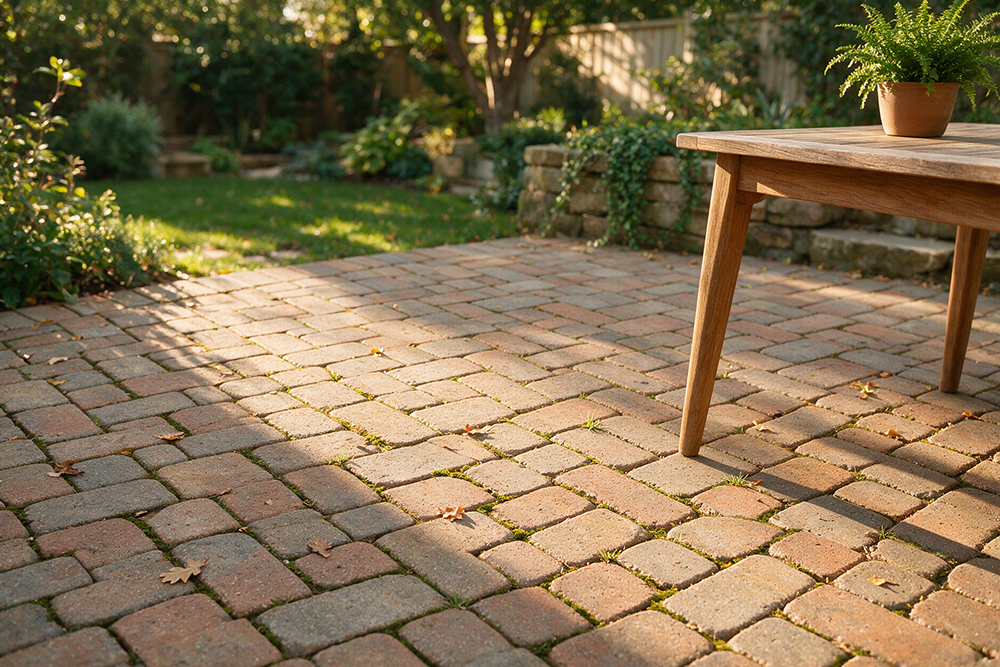
Two concerns come up almost every time a homeowner is seriously considering a paver driveway or patio: weeds growing through the joints, and the surface sinking or developing dips over time. Both are real problems, but they are problems with bad installations, not with pavers. Talk to Benchmark Pavers at (352) 651-6077 about how a properly installed paver surface is built to avoid both.
Is it true that pavers always end up full of weeds?
This is the most persistent myth in the paver industry, and it is rooted in real experience with poorly installed surfaces. Weeds that appear to grow through paver joints are not usually coming up from below. They are germinating in organic debris, dirt, and dust that accumulates in open joints over time. The joint is the entry point, not the root source.
The solution is polymeric bonding sand. When properly applied between paver joints and activated with water, polymeric sand hardens and binds within the joint, creating a surface that resists both weed germination and insect intrusion. A well-installed paver driveway or patio using quality polymeric sand in the joints, maintained with sealer every two to three years, should not develop meaningful weed problems. The ones that do are almost always surfaces where the wrong sand was used, the sand was not properly activated, or maintenance was skipped for years.
Do paver driveways actually sink or develop dips over time?
They can, and when they do, the root cause is almost always the base. Pavers themselves do not sink. The ground beneath them can shift if the base was not properly prepared and compacted before installation, and when the base moves, the pavers above it follow. A surface installed over an inadequately compacted base will develop dips, uneven areas, and joint separation as the base settles.
Proper base preparation is non-negotiable for a driveway or patio that holds its shape over time. This means excavating to the correct depth, bringing in the right base material, and compacting it in layers before any bedding material or pavers go down. At Benchmark Pavers, the installation process puts specific attention on base compaction because that is where the long-term stability of the surface is decided, not at the top layer.
What about the bedding layer under the pavers? Does that matter?
Significantly. Limestone screenings, also called stone dust, are a commonly used and highly effective bedding material when applied correctly. The key word is compaction. Screenings that are laid loosely and not compacted before the pavers go down can shift over time, contributing to the surface movement that creates dips and unevenness.
When limestone screenings are properly compacted, they create a stable, consistent bedding layer that has been tested across thousands of installations over decades. The material itself is not the problem when pavers develop issues. The installation process is. That distinction matters because it means a surface built correctly from the start should not exhibit these problems.
What maintenance does a paver surface actually need to stay weed-free and level?
The maintenance ask is simple and the schedule is realistic for any homeowner. Sealing pavers every two to three years is the single most effective thing a homeowner can do to maintain surface performance. A quality paver sealer reinforces the polymeric sand in the joints, limits weed germination, protects the surface color, and makes routine cleaning easier. Skip sealing for five or six years and the joint material degrades, weeds find purchase, and the surface loses the protection that keeps it performing well. Ask about paver sealing when you reach out for a project consultation.
A well-installed paver surface that is sealed on schedule is not a high-maintenance investment. It is one of the lower-maintenance hard surface options available for driveways and outdoor living areas. The reputation for weeds and sinking comes from surfaces that were either installed incorrectly or neglected for years. It is not inherent to the material. Contact Benchmark Pavers at (352) 651-6077 to learn what a correctly installed paver surface looks like from the ground up.
Get in touch with us
Don’t hesitate to get in touch with us today to schedule a consultation and learn how we can help you achieve your construction goals.