
Getting quotes for a new paver driveway is straightforward. Knowing which quote represents a lasting installation and which one will have you calling someone else in three years takes a few more questions. Benchmark Pavers welcomes those questions at (352) 651-6077 or through our online contact form, and we will walk you through every detail before anything is signed.
Ocala homeowners comparing paver driveway bids quickly discover that prices vary more than the scope of work seems to explain. A contractor quoting significantly below the others is not necessarily offering a deal. They are more often skipping something, and what gets skipped on a paver installation almost always lives underground, where you will not see the consequences until the surface starts shifting, settling, or separating two summers from now. Here is how to compare contractors on the factors that actually determine how long your driveway lasts.
Why Does Base Excavation and Compaction Determine How Long a Paver Driveway Lasts?
The pavers themselves are not what fails on a poorly built driveway. The base underneath them is. A paver surface is only as stable as the compacted aggregate it rests on, and that aggregate is only as solid as the subgrade preparation beneath it. Florida's sandy soil in Marion County drains well in some respects but compresses under load and shifts with moisture changes in ways that an improperly prepared base will follow. The result is pavers that rock, joints that open up, and edges that drop away from the field over time.
A properly built paver driveway in Ocala requires excavation to a depth that removes the organic topsoil layer and reaches stable native material. On top of that, a base course of crushed aggregate, typically limerock or compacted gravel, is installed in lifts and compacted with a plate compactor between each layer. The depth of that base depends on the load the driveway will carry. A standard residential driveway handling passenger vehicles needs a different base depth than one regularly supporting delivery trucks or heavy SUVs with trailers. A contractor who does not ask about your usage before specifying base depth is not customizing the installation to your situation.
Ask every contractor you are evaluating how deep they excavate, what base material they use, and how many compaction passes they run. The answers should be specific. A vague response about doing things the right way without measurable details is not a sufficient answer when the question is about what goes under a surface you are going to drive on for the next twenty years.
How Do Edge Restraint and Drainage Affect a Florida Paver Driveway?
Edge restraint is what keeps the field of pavers from migrating outward over time. Without a properly installed restraint system along every exposed edge of the driveway, the lateral pressure of vehicle traffic gradually pushes the outer pavers away from the field, opening joints and creating the uneven, spreading look that signals a driveway that was not built to hold. Plastic edge restraint spiked into the base at the correct intervals is standard on a quality installation. A contractor who omits it or installs it inconsistently is handing you a problem that will show up within a few seasons.
Drainage matters more in Florida than in most of the country. Ocala receives significant rainfall, and a driveway that does not direct water away from the structure and off the surface correctly creates pooling that accelerates base erosion and eventually compromises the paver field above it. The driveway's slope needs to be calculated and built into the grade before any base material is laid, because correcting drainage after the fact means pulling up the surface and regrading from scratch.
Ask the contractor how they handle positive drainage away from the home's foundation and whether the driveway grade is specified in the bid. If the property has existing drainage issues, ask how the installation addresses them rather than works around them. A crew that understands Florida soil and water behavior will have direct answers to these questions. One that has not thought through the drainage design for your specific lot has not done the pre-installation assessment the job requires.
What Should a Real Paver Driveway Warranty Actually Cover?
Warranty language in paver installation bids varies widely, and the differences matter. A manufacturer warranty on the paver product itself is not the same as a contractor warranty on the installation. The pavers rarely fail. The base preparation, the compaction, the edge restraint, and the joint sand are what determine whether the surface holds up, and those are the contractor's work, not the manufacturer's.
A warranty worth having covers the installation workmanship for a meaningful period, typically one to three years at minimum, and specifies what it includes. Settling beyond a defined tolerance, joint sand washout requiring reset, and edge restraint failure should all be covered. A warranty that covers only obvious structural collapse or one that is so broadly written that almost any claim falls outside its scope is not real protection. Read the warranty language before you sign the contract and ask the contractor to explain exactly what scenario would and would not be covered under it.
Also ask whether the company will still be operating to honor the warranty. A legitimate local contractor with a track record in Marion County and verifiable references from completed Ocala driveways is a different risk profile than a crew that materialized recently and cannot point to work you can go look at. A warranty from a company you cannot locate in two years is worth nothing.
What Red Flags Show Up in a Suspiciously Low Paver Bid?
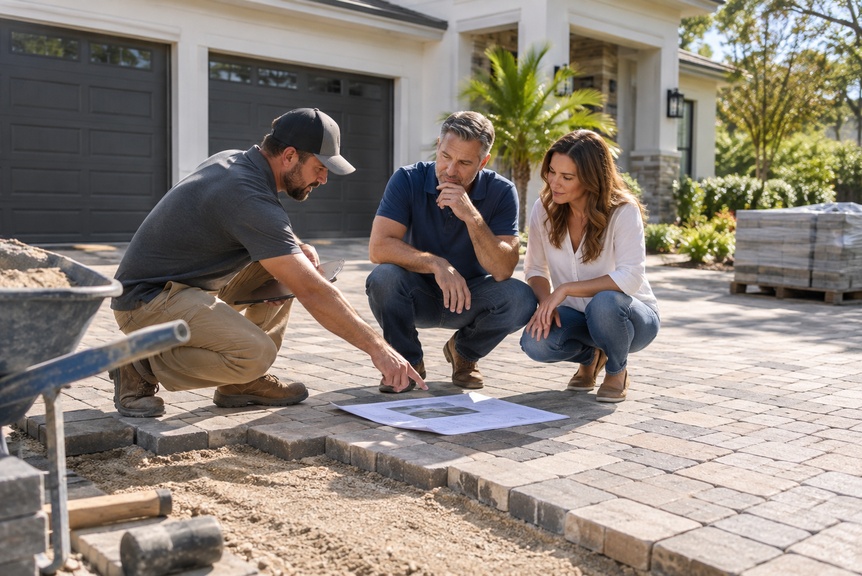
We recently worked with longtime Ocala homeowners who needed their driveway replaced and came to us unsure what questions to ask and worried about choosing the wrong contractor. They had received several bids that ranged considerably in price and did not know how to evaluate them. We walked them through every decision, from base depth and compaction specs to edge restraint and drainage planning, and made the process clear without rushing them toward any particular choice. They knew exactly what they were getting before any work started, and the installation reflected that preparation.
The red flags that typically explain a low bid are consistent. Shallow base depth cuts material and compaction time. Omitting edge restraint saves product cost. Skipping a drainage evaluation saves assessment time. Using undersized or lower-grade base aggregate saves per-ton cost. None of these shortcuts show on the surface when the job is done. They show eighteen months later when the driveway starts to move.
A bid that does not specify excavation depth, base material type, compaction method, or edge restraint system in writing is a bid for an undefined scope of work. When you ask the contractor to add those details and the response is reluctance or vague reassurance, that is the answer. A crew confident in their process will put the process in the proposal without being asked twice.
If you are comparing patio and driveway paver installation bids in Ocala and want a detailed on-site estimate that specifies exactly what goes into the ground, call Benchmark Pavers at (352) 651-6077 or request your estimate online. We will show you what a properly built driveway looks like before you commit to anything.
Get in touch with us
Don’t hesitate to get in touch with us today to schedule a consultation and learn how we can help you achieve your construction goals.